
Title II Today: Compliance & Accessibility Insights for October 12, 2026 – Volume 120
 |
 |
 |
|
 |
|
 |
|
 |
|
 |
🏛️ The Month’s News in Title II Compliance
Title II Today. The world’s leading ADA Title II Compliance publication.
A Pneuma Solutions Publication
Subscribers: 9,004 🔢️ opt-in subscribers were sent this issue via email.
Social Media: 201,467 🔢️ readers were sent this issue via social media. Courtesy of the PWD Media Co-op.
Access Awareness: Updates That Matter
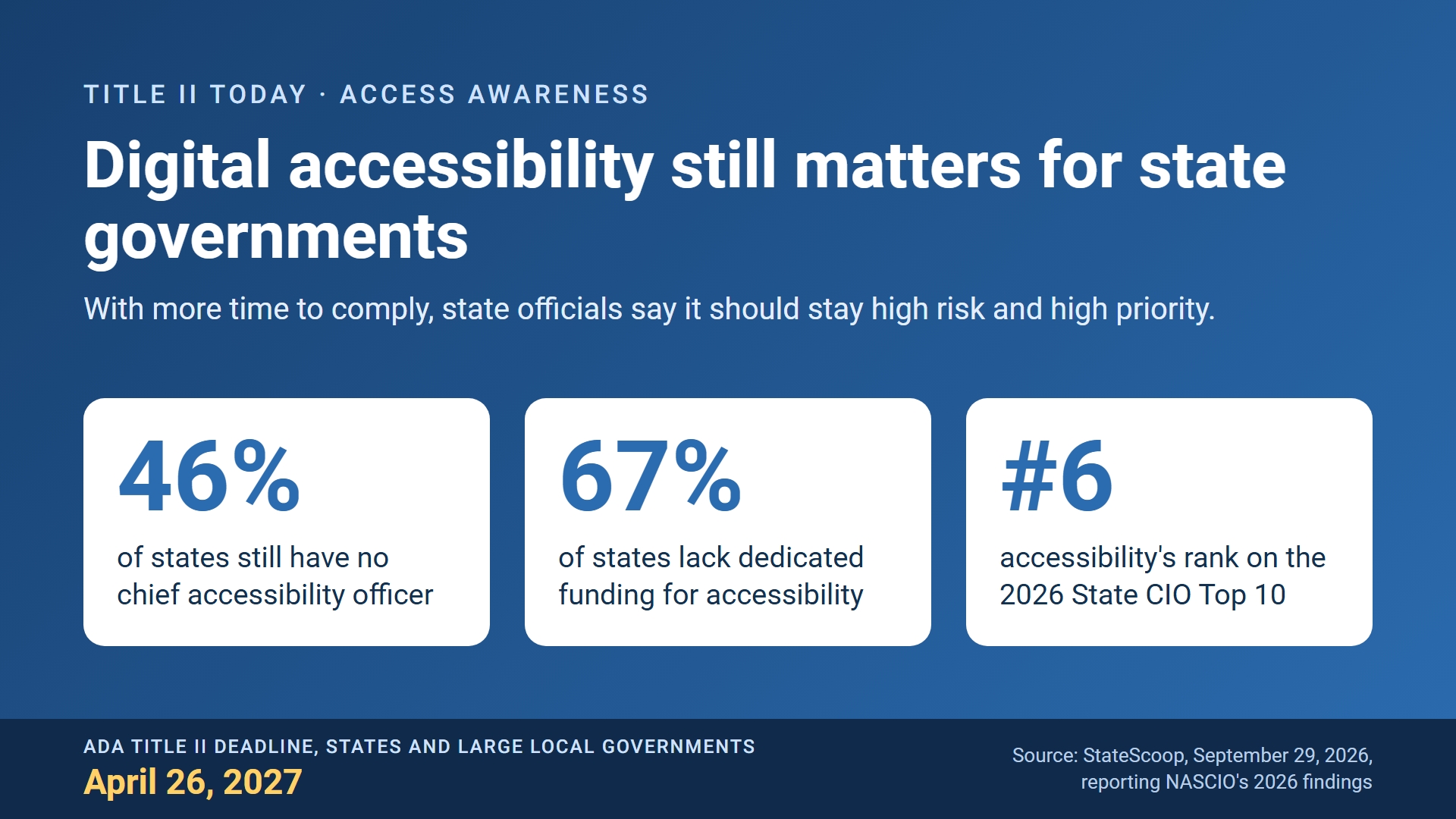
As Federal Deadlines Shift, Officials Say Digital Accessibility Still Matters for State Governments Despite Gaps in Funding, Leadership | StateScoop.com | September 29, 2026
Although the DOJ pushed its Title II mobile-app accessibility compliance deadline to April 26, 2027, state officials at NASCIO say the delay does not reduce the risk. NASCIO’s 2026 survey found 46% of states lack a chief accessibility officer and 67% have no dedicated funding; Texas and Pennsylvania leaders urged risk-based remediation of high-traffic systems.
Featured Advertisement
Your Archive Is Massive. Your Document Accessibility Shouldn’t Be Metered by the Page. ✅ Accessible Archive From Pneuma Solutions

🔗 https://pneumasolutions.com/accessiblearchive/
Unlimited Document Processing. One Platform. Three Ways to Deploy.
ADA Title II Deadline: April 26, 2027
State & local governments (population 50,000+) must ensure websites, mobile apps, and digital documents comply with WCAG 2.1 Level AA.
Courts, agencies, universities, and libraries share the same reality: decades of PDFs/scans in “permanent” archives, and a compliance obligation to make them accessible. Manually remediating millions of files isn’t a strategy; it’s ongoing compliance exposure. Neither is pricing that meters every page, which quietly turns a compliance obligation into a budget exercise. That’s why Pneuma Solutions built Accessible Archive.
🎯 Built For
Courts and records offices; state, county and municipal agencies; university/academic libraries; public libraries/state archives; museums/cultural institutions; large enterprises with document management systems full of old PDFs.
If you own legacy content + accessibility, it’s for you.
💰 Unlimited by Design
Traditional: “Pay per page, per document, forever.” You remediate what the budget allows, not what people actually need.
✅ New Model: Predictable, deployment-based licensing with unlimited pages — no per-page charges and no per-document charges. Licensing by deployment removes the pricing incentive to limit accessibility work to only a subset of your documents.
What unlimited means: no Pneuma-imposed limit on the number of documents or pages processed. Throughput is determined by the capacity of your deployment. Pneuma-hosted processing and storage are billed separately.
📄 You Get the Actual Accessible PDF Back
Not an overlay. Not a viewer. Not a read-only preview. Accessible Archive hands a real, tagged, accessible PDF → straight back into your workflow, as a file you can store, index, serve, re-publish and hand to an auditor. Accessible HTML, MP3, braille and large print come out of the same conversion.
🔁 Re-Remediation, on Your Terms
Cached results can be reused, and documents can be automatically re-remediated as the technology evolves. How that runs is yours to configure.
- 👉 Set it and forget it — updated remediation happens automatically as the engine improves.
- 👉 Human in the loop — review and approval before anything is republished.
Accessible Archive supports fully automated processing and workflows that include human review. You choose which one fits.
⚙️ Three Ways to Deploy
- 👉 Cloud — the simplest way in. Nothing to install, nothing to host.
- 👉 Integrated — an API-connected workflow. Your system sends the document to Accessible Archive through the API and receives the accessible PDF back through the same connection, inside the tools you already run: catalog, DMS, repository, intranet or public portal.
- 👉 On-Premises — Runs entirely inside your network for content that cannot leave it.
All traffic is encrypted; you control what’s retained beyond caching + audit evidence.
🧠 Three Ways to Feed It
- 📄 User-requested documents — someone asks for a file from your catalog/DMS/portal, and the accessible PDF comes back through that same request.
- 📄 Continuous intake and publishing — filings, agendas, minutes and records are made accessible as they arrive, so you stop manufacturing next year’s backlog.
- 📄 Existing collections — point it at the archive you already have and work straight through it.
📊 Compliance, With Receipts
Not just files: timestamps, pipeline/version info, and input/output hashes to prove which file became which accessible version. Output is designed to align with WCAG and PDF/UA, so the evidence supports your compliance work and shows auditors and regulators what you did at scale.
✅ For Leaders of Large Collections
If a person with a print disability browsed your archive today: how many docs could they use, and could you hand them the accessible file itself — not a promise and a ticket number?
If that answer is uncomfortable, ask Pneuma Solutions what Accessible Archive looks like against your repository. Email remediation@pneumasolutions.com and see what happens when accessibility stops being a line item and becomes part of the workflow you already run.
News
1.) Top 5 Most Clicked News Articles From Last Month
A.) ADA Web Rule Sends Legislatures Racing Toward Digital Access | NCSL.org | September 2, 2026
Federal rules issued by the DOJ and HHS in 2024 require public digital content to meet WCAG 2.1 Level AA, pushing legislatures toward 2027 or 2028 compliance deadlines. Colorado, Minnesota and Wisconsin officials say the work requires workflow-integrated checks, staff training and plans for difficult archives, PDFs and legislative markup.
B.) DOJ Abandons Olmstead Defense as Texas v Kennedy Advances | AJMC.com | August 28, 2026
After a June 18 Office of Legal Counsel opinion, DOJ said it will no longer rely on its 2011 Olmstead guidance when enforcing ADA Title II, weakening federal backing for the integration mandate. The shift puts HHS closer to Texas, Alaska, and Florida in Texas v Kennedy, which challenges HHS’s 2024 Section 504 rule.
C.) Accessibility Legal Update July 2026 | ConvergeAccessibility.com | August 3, 2026
An Illinois federal court dismissed Cole v. Kingsmen Premium after a visually impaired plaintiff alleged only one visit and generic interest in grooming products, finding no plausible intent to return for ADA injunctive standing. In California, Richard Merrell’s Ralph Lauren ADA class was certified, but an Unruh class failed over individualized proof of intent to transact.
D.) AI and Accessibility for Ecommerce: What the Tools Really Do and What They Don’t | BlogUsableNet.com | August 5, 2026
WebAIM’s 2026 Million study found detectable WCAG failures on 95.9% of one million home pages, with 56.1 errors per page on average. UsableNet’s Jeff Adams says AI can rapidly replicate inaccessible patterns and that automated scans cover only roughly 25% to 30% of WCAG, requiring expert and assistive-technology-user testing.
E.) Statement of National Disability Organizations on the Department of Justice’s Proposed Resolution of Texas V. Kennedy | DREDF.org | September 1, 2026
On August 31, 2026, DOJ, acting for HHS, joined Texas, Florida, and Alaska in seeking a court order to vacate community-integration references in HHS’s 2024 Section 504 regulations. DREDF and six other disability-rights organizations condemn the proposed Texas v. Kennedy resolution, saying it cannot alter Section 504, the ADA, or longstanding Olmstead precedent.
2.) Troy City Council Passes ADA Transition Plan Resolution | TimesTribuneNews.com | October 10, 2026
Troy City Council approved a resolution continuing the city’s ADA transition plan, first approved in 2016, covering sidewalk, curb-ramp and shared-use-path upgrades. The council also authorized Mayor David Nonn to seek CDBG funding for Franklin Street reconstruction and approved the PM Office Park minor subdivision plat.
3.) Make Your Plan to Vote in the Midterm Election | Disability.state.mn.us | October 9, 2026
Minnesota’s November 3, 2026 midterm election offers early voting beginning October 16, while absentee ballots have been available since September 18. The Minnesota Council on Disability outlines registration, mail-ballot deadlines, accessible absentee ballots, curbside voting, ballot-marking machines, and assistance rules.
4.) San Francisco Refuses to Stop Messing With the ADA. We Need Your Voice Again. | DREDF.org | October 9, 2026
San Francisco City Attorney David Chiu rejected a request from DREDF, the ACLU Disability Rights Program, and more than 150 disability groups and residents to meet and withdraw arguments in Kirola v. City and County of San Francisco. DREDF says those arguments could weaken ADA and Section 504 enforcement across the Ninth Circuit’s nine states and two territories.
5.) Decorative Images… | AdrianRoselli.com | October 9, 2026
Adrian Roselli rejects the category of decorative images in narrative content, contending that an image worth keeping conveys mood, theme, or other meaning that should be available in text. His adapted WAI decision tree tests removal and substitution with an irrelevant image, steering authors toward removal or an appropriate alt text alternative.
6.) Rules Expanding Access to Accessible Medical Equipment Take Effect | DisabilityBelongs.org | October 8, 2026
New HHS and DOJ requirements now require many federally funded health care providers and state and local government programs to have at least one accessible exam table and weight scale, with July 8 and August 9, 2026 deadlines. A 2025 GAO report found inaccessible equipment can delay care and prevent accurate weigh-ins; staff training and patient notice are also needed.
7.) Supreme Court Sidesteps Employment Law Cases on Disability Bias, Vaccines | HRDive.com | October 7, 2026
The Supreme Court declined several employment-law petitions at the start of its 2026-2027 term, leaving appeals-court rulings intact on disability discrimination, COVID-19 vaccine and testing mandates, and labor disputes. Denials included Greer, Redding, Colson, Troogstad, Petersen and NLRB-related cases.
8.) In Win for Voters With Disabilities, Court Strikes Down California Mail Ballot Rule | DemocracyDocket.com | October 5, 2026
A federal court struck down California’s requirement that mail voters return paper ballots without assistance, finding it violated state and federal law for voters with print disabilities. U.S. Magistrate Judge Sallie Kim said requiring another person’s help is incompatible with private, secret voting; a remedy hearing is set for Oct. 19, though the ruling likely will not change this fall’s procedures.
9.) ADA Title II and K12 Digital Content: What the New Compliance Deadlines Mean for Publishers | MagicBox.com | October 5, 2026
The DOJ’s ADA Title II digital-accessibility rules took effect April 20, 2026, making districts accountable for the accessibility of licensed third-party K-12 content. MagicBox says large districts face an April 26, 2027 deadline and smaller districts April 26, 2028, elevating WCAG 2.1 AA evidence and VPATs in procurement.
10.) Designing for People Who Are Colour Blind | TetraLogical.com | October 2, 2026
Colour blindness can obscure important information, interactive states and data when interfaces rely on colour alone, TetraLogical’s Demelza Feltham writes. The guidance pairs WCAG 1.4.1 with practical measures: add text, icons or patterns; maintain contrast; avoid red-green and purple-blue distinctions; and test interactive states beyond static screens.
11.) How to Make Your Google Forms More Accessible | PopeTech.tech | October 2, 2026
Pope Tech recommends replacing Google Forms’ native date picker with text or single-select questions because accessibility varies across browser, OS, and assistive-technology combinations. The guidance also calls for captions as image alt text, 4.5:1 contrast for normal text, 12pt type, and titled, full-size iframe embeds that are keyboard-tested.
12.) Reps. Dean and Scanlon Introduce Bills to Make American Democracy More Accessible to People With Disabilities | Dean.house.gov | October 1, 2026
Reps. Madeleine Dean and Mary Gay Scanlon introduced three bills targeting disability-access barriers in voter registration, ballot casting, candidacy, and local government service. The package includes benefit protections for candidates, local accommodations funding, and a national accessible-voting resource center.
13.) Digital Accessibility Deadline Demands a Focus on Procurement | UniversityBusiness.com | September 30, 2026
The DOJ’s one-year extension gives most state and local governments, including public universities, until April 26, 2027, and Glenda Sims argues procurement should come first because institutions answer for vendor code they cannot fix. She urges inventorying third-party tools, testing vendor claims, tracking fixes and writing accessibility requirements into contracts, warning that a National Federation of the Blind lawsuit could restore the original deadlines.
14.) ADA Title II Deadline for Small Towns: 2028 | ReadableTown.com | September 29, 2026
Small towns, counties under 50,000 people, and special districts must meet WCAG 2.1 Level AA for public web content and mobile apps by April 26, 2028, under DOJ’s April 20, 2026 interim final rule. The deadline faces a National Federation of the Blind lawsuit, while DOJ is considering revisions; Colorado entities remain subject to state rules already in force.
15.) Community Living Is a Civil Right: A Guide to Understanding Olmstead v. Lois Curtis, the Integration Mandate, and the 2026 Office of Legal Counsel Opinion | DREDF.org | September 29, 2026
On June 18, 2026, DOJ’s Office of Legal Counsel issued an opinion asserting that the ADA and Section 504 do not require services in the most integrated setting. DREDF and AAPD say Olmstead v. L.C. remains controlling law, while a September 23 Texas v. Kennedy order vacated HHS’s Section 504 integration provisions nationwide.
16.) The DCIC Applauds Bipartisan House Resolution Reaffirming the Right of Disabled People to Live in Their Communities | AAPD.com | September 29, 2026
A bipartisan House resolution, H.Res. 1586, would reaffirm that the Olmstead decision reflects Congress’s intent for disabled people to receive services in their communities rather than institutions. The Defend Community Integration Coalition credited Reps. Debbie Dingell and Brian Fitzpatrick and called for investment in home- and community-based services and the direct-care workforce.
17.) Healthcare Web Teams: Tips to Meet Section 504 Accessibility by May 2027 | Stamats.com | September 28, 2026
HHS’s 2024 Section 504 update requires federally funded healthcare providers to make websites, mobile apps, portals, forms, and third-party digital services conform to WCAG 2.1 Level AA. Organizations with 15 or more employees face a May 11, 2027 deadline; smaller providers have until May 10, 2028, with OCR investigations and possible funding consequences for noncompliance.
18.) #Corpowid and #Skynet Technologies Will Get You Sued | AdrianRoselli.com | September 28, 2026
Adrian Roselli reports that Corpowid and Skynet Technologies accessibility overlays introduce WCAG violations rather than remediate them. His tests found Corpowid’s widget created overflow and off-screen navigation, while Skynet’s “Sign Language Font” replaces text with ASL fingerspelling and does not adapt for BSL or Auslan.
19.) A11y 101 – 3.3.8 Accessible Authentication (Minimum) | Tarnoff.info | September 28, 2026
WCAG 2.2 success criterion 3.3.8 requires an accessible authentication path that does not depend on cognitive-function tests such as memorization, visual pattern recognition, or CAPTCHA challenges. The guidance calls for password-manager-friendly autocomplete and paste support, plus alternatives including magic links, biometrics, hardware tokens, and visible recovery options.
20.) Civil Rights Enforcement Cuts Mean Fewer Staff, Closed Offices, Longer Waits for Students With Disabilities | PBS.org | September 27, 2026
Following workforce cuts and the closure of seven regional offices, the Education Department’s Office for Civil Rights has become harder for families to reach, disability advocates say. GAO found that OCR received more than 9,000 complaints from March through September 2025 and classified over 7,000 as resolved, with about 90% dismissed.
21.) A Trump Team Wants to Automate U.S. Web Design System Accessibility Testing. Experts Are Worried. | FedScoop.com | September 25, 2026
GSA’s new U.S. Web Design System team, led by Treasury AI engineer Ryan Parker after former lead Anne Petersen was removed, says it wants to automate as much accessibility testing as possible. Former engineering lead Matt Henry says only about 30% can be reliably automated, while Sheri Byrne-Haber warns AI misses violations affecting assistive-technology users.
22.) Crafting WCAG 3 for More Accessible User Experiences | W3.org | September 25, 2026
W3C WAI Director Shawn Lawton Henry covers the stakes and challenges involved in developing W3C Accessibility Guidelines (WCAG) 3, the next generation of the web accessibility standard. The WAI news post directs readers to Henry’s W3C blog post, published September 25, 2026.
23.) National Disability Organizations Condemn the Federal Government’s Abandonment of Its Commitment to Community Integration for People With Disabilities, As Approved by the Court in Texas V. Kennedy | ACLU.org | September 24, 2026
A federal district court in Texas approved a settlement vacating HHS Section 504 regulations that referenced a right to community integration for people with disabilities. Disability organizations said the order breaks with decades of precedent, while leaving the statute, the rest of the 2024 HHS rule, and other agencies’ regulations intact.
24.) City Needs About $1.8M for Parks, Buildings to Be Fully ADA-Compliant | PeninsulaDailyNews.com | September 23, 2026
A Transpo Group study found 10,619 ADA accessibility barriers across eight Sequim parks and seven city buildings, with remediation estimated at about $1.84 million. At roughly $50,000 a year in current ADA spending, the consultant said the work could take 37 years; the City Council scheduled a Sept. 28 public hearing on its proposed transition plan.
25.) Title II As a Viable Approach in Addition to the Eighth Amendment and Other Great Stuff | UnderstandingTheADA.com | September 22, 2026
The Ninth Circuit’s published September 8 ruling in Adom v. California Department of Corrections and Rehabilitation revives a Title II ADA claim over the termination of an incarcerated man’s incontinence supplies. The court held that a diagnosis or medical prescription is not required for disability status and said a jury could find deliberate indifference after officials ended a prior accommodation without new inquiry.
26.) Missouri SB 907: What the New Web Accessibility Law Does | Silktide.com | September 22, 2026
Missouri’s Act Against Abusive Website or Web Content Access Litigation took effect August 28, creating a state-court counter-suit route for defendants in web accessibility cases, with fee awards and sanctions up to triple fees. Jessica Chambers says SB 907 omits Kansas’s plaintiff protections, extends eligibility to public bodies, and may leave Section 504-only claims outside its scope.
27.) Foundations: the Accessibility Tree | TetraLogical.com | September 22, 2026
Modern screen readers consume the browser’s accessibility tree, not the rendered screen or raw DOM. Craig Abbott explains how browsers derive each node’s name, role, and state from HTML, CSS, and ARIA, and why Chrome and Firefox developer tools make missing labels, incorrect roles, hidden content, and reading-order faults easier to spot.
28.) The Clock Is Ticking: Accessibility Deadline Upcoming for School Websites | Blog.TCEA.org | September 17, 2026
The DOJ’s revised ADA Title II web-accessibility rule requires public schools and districts to meet WCAG 2.1 AA for websites and mobile apps by April 26, 2027 if they serve jurisdictions of 50,000 or more; smaller entities have until April 26, 2028. Vendor-hosted portals, LMS platforms, PDFs, videos, and forms are covered too.
29.) Centre County Changes Several Polling Places After First Phase of Accessibility Audit | StateCollege.com | September 16, 2026
Centre County will move polling places for six precincts before the Nov. 3 election after initial federal ADA compliance audits of 15 voting sites. The Board of Elections approved the relocations Sept. 10, while commissioners authorized a second, countywide audit phase with Dan Willis Architecture capped at $15,000.
30.) What Your Colorado Accessibility Plan Should Say | A11y.is | September 16, 2026
Colorado public entities relying on an accessibility plan must publish it on their website, show good-faith progress across active ICT, and update it annually. After reviewing 26 plans and statements, A11y Is found many omit their compliance route, visible dates, usable contact channels, or evidence beyond scanner scores.
31.) Your Accessibility Tests Stop at the Page. Your Users Don’t. | AFixt.com | September 15, 2026
Automated accessibility scans can pass while critical workflows still fail, Karl Groves writes, because page-state checks do not validate keyboard operation, focus management, dynamic errors, or screen-reader feedback. AFixt proposes executable use-case scripts that identify controls by role and accessible name, assert interaction outcomes, scan post-action states, and turn audit fixes into regression tests.
32.) Governors Line Up Against Bid to Scale Back Community-Based Services | DisabilityScoop.com | September 15, 2026
Governors of 18 states urged Attorney General Todd W. Blanche to reject a Justice Department memo that questions longstanding interpretations of Olmstead v. L.C. The 1999 Supreme Court ruling requires community-based treatment in certain circumstances, helping drive efforts to move people with disabilities out of institutions.
33.) Accessible Email for Public Entities | A11y.is | September 14, 2026
Colorado has not ruled explicitly on whether public-entity email is covered technology, but its accessibility statutes focus on equal access to services rather than a specific channel. Public browser archives for newsletters are plainly web pages, while image-only alerts, weak alt text, vague links, and inaccessible templates can deny critical service information.
34.) Digital Accessibility for Colorado Special Districts | A11y.is | September 14, 2026
Colorado special districts have been subject to HB21-1110’s digital accessibility requirements since July 1, 2025, with no small-entity exemption across roughly 4,000 districts. The April 2026 DOJ extension moves their federal ADA Title II deadline to April 26, 2028, but does not alter Colorado’s deadline; districts must post an accessibility statement and can publish and annually update a compliance plan.
35.) Sustainable Accessibility: Compliance, Culture, and Capability | TetraLogical.com | September 14, 2026
Craig Abbott says accessibility programs become a costly loop when organizations rely on point-in-time assessments and compliance checklists. TetraLogical’s three-C model pairs compliance with culture and capability; it cites the UK’s Department for Work and Pensions, with more than 80,000 employees, as an implementation.
Deadlines For Compliance
April 26, 2027 | Title II Deadline | ADA | Formerly: April 24, 2026
State and local governments with a population of 50,000 or more must ensure their websites, mobile apps, and digital documents comply with WCAG 2.1 Level AA.
April 26, 2028 | Title II Deadline | ADA | Formerly: April 26, 2027
State and local governments with fewer than 50,000 people, as well as all special district governments, must achieve full compliance with WCAG 2.1 Level AA.
* Standard remains WCAG 2.1 Level AA. Scope, exceptions, and underlying Title II obligations are unchanged. Only the compliance dates moved.
➜ Title II Today News Team
Distribution: Pneuma Solutions
Distribution Since: 2025
As of March 17, 2025 the distribution of Title II Today is made possible by Pneuma Solutions, a leading international provider of AI-powered digital accessibility solutions, specializing in document remediation, remote assistance technology, and real-time accessibility tools for individuals with disabilities.
Any time the Title II Today Publication carries less than its Sponsor limit, Pneuma Solutions donates the remaining dollars necessary to keep the publication running.
Publisher: Aaron Di Blasi, PMP
Publisher Since: March 17, 2025
Location: Cleveland, Ohio
Time Zone: Eastern Standard Time (EST/EDT) (GMT-5/GMT-4)
In addition to serving as Publisher for Title II Today, Aaron Di Blasi also serves as Publisher for the Top Tech Tidbits, Access Information News and AI-Weekly newsletters.
As Publisher Aaron oversees the monthly distribution of Title II Today on behalf of Pneuma Solutions.
Aaron Di Blasi, PMP
Email: publisher@title2.info 📧️
Toll Free: +1 (855) 578-6660 📱️
Publisher (2025-Present)
Title II Today: Compliance & Accessibility Insights
The Month’s News in Title II Compliance
Subscription Information 📰️ABOUT 🏛️Founded in 2025, Title II Today is the world’s leading ADA Title II Compliance publication that reaches over 9,000 government officials, public sector employees, educators, public school administrators, accessibility & inclusion advocates, legal & policy experts, tech & UX professionals and nonprofits & advocacy organizations, all over the world, each month. Subscribe here. Review the most recent issues here. Title II Today: Compliance & Accessibility Insights delivers essential monthly updates on ADA Title II enforcement, digital accessibility best practices, and practical compliance strategies for public sector professionals. Stay ahead of DOJ deadlines, legal risks, and accessibility innovations with expert insights, real-world case studies, and actionable guidance to ensure your government websites, documents, and mobile apps meet WCAG 2.1 standards. Title II Today is a Pneuma Solutions Publication. Publisher: Aaron Di Blasi. RELEASE SCHEDULE 📅️Title II Today is released on the 2nd Monday of each month at 6:00 AM ET. SUBSCRIBE 📧️Do you, a friend, or colleague wish to receive the Title II Today newsletter? If so, please use or pass along our free sign-up link. You can also subscribe to receive the Title II Today newsletter on the Title II Today Website. Either of these methods will provide you with an accessibly friendly and secure medium through which you can subscribe to our mailing list. Just enter your email address, click send, and begin receiving the Title II Today newsletter. It’s that easy. WEBSITE 🌐️Visit the Title II Today website online at: https://title2.info/. RSS 📡️Do you prefer RSS? Follow Title II Today via RSS today to begin receiving current news and trends in Title II Compliance using your choice of news aggregator. THANK YOU 🙏️Thank you for reading. On behalf of all of us here at Title II Today we look forward to keeping you informed. |