
Title II Today: Compliance & Accessibility Insights for November 9, 2026 – Volume 121
 |
 |
 |
|
 |
|
 |
|
 |
|
 |
🏛️ The Month’s News in Title II Compliance
Title II Today. The world’s leading ADA Title II Compliance publication.
A Pneuma Solutions Publication
Subscribers: 9,407 🔢️ opt-in subscribers were sent this issue via email.
Social Media: 202,467 🔢️ readers were sent this issue via social media. Courtesy of the PWD Media Co-op.
Access Awareness: Updates That Matter
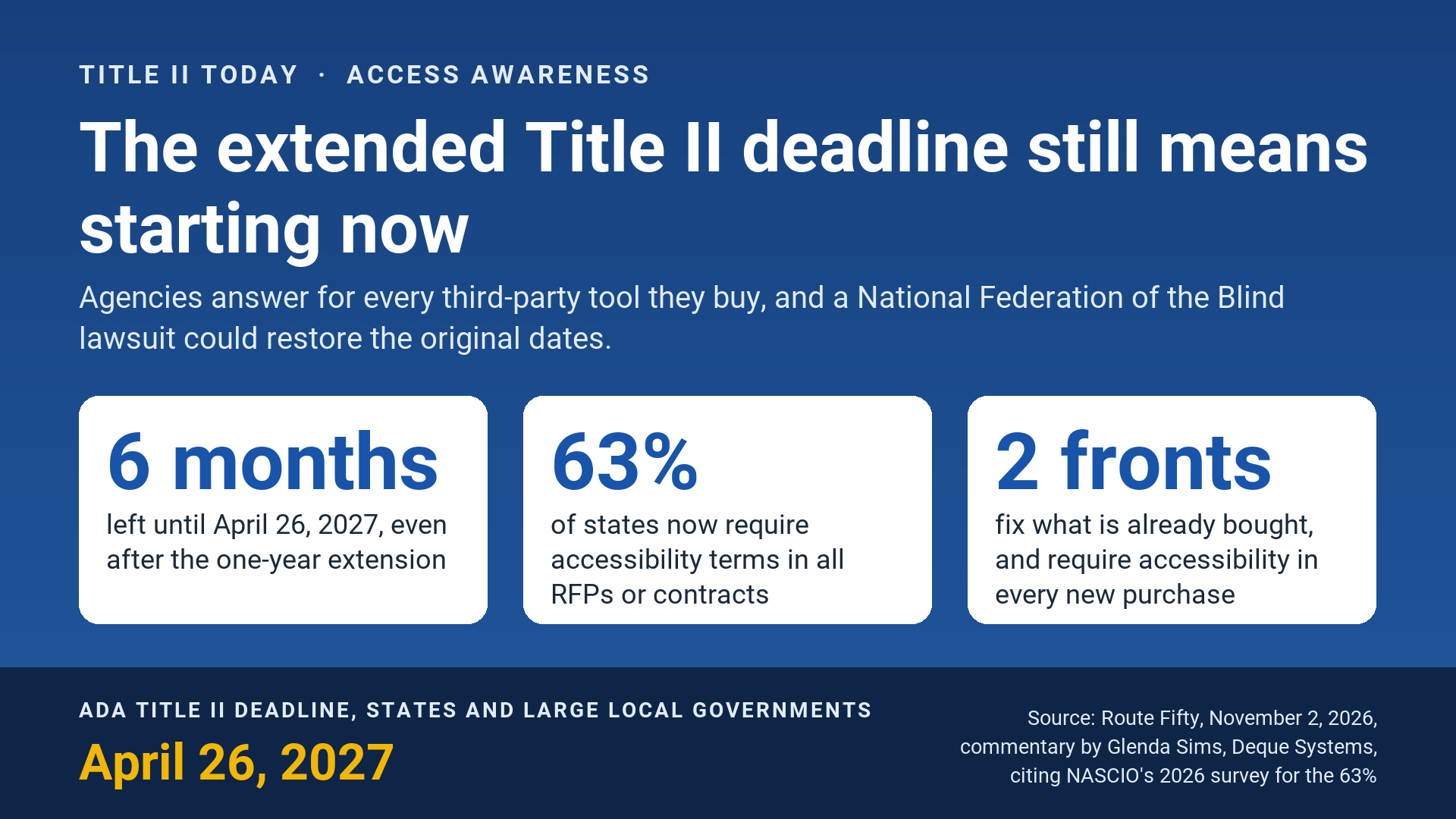
Extended ADA Title II Deadline Demands a Focus on Procurement | RouteFifty.com | November 2, 2026
The Justice Department’s one-year extension gives most state and local agencies until April 26, 2027, but Glenda Sims of Deque Systems argues that is still a tight timeline, because agencies are responsible for every third-party tool and document they buy. She urges auditing what is already in place, writing enforceable accessibility terms into contracts and starting now, since a National Federation of the Blind lawsuit could restore the original dates.
Featured Advertisement
Stop Deciding Which Documents Get to Be Accessible. ✅ Accessible Archive From Pneuma Solutions

🔗 https://pneumasolutions.com/accessiblearchive/
One Platform. Three Ways to Use It. No Per-Page Remediation Charge on Your Own Infrastructure.
ADA Title II Deadline: April 26, 2027
State & local governments (population 50,000+) must ensure websites, mobile apps, and digital documents comply with WCAG 2.1 Level AA.
Courts, agencies, universities and libraries share the same reality: decades of PDFs and scans sitting in permanent archives, new documents arriving every single day, and one compliance obligation covering both. What usually happens next is triage — somebody decides which documents get to be accessible, because that is what the budget allows. Accessible Archive is built to take that decision off the table.
🎯 Built For
Courts and records offices; state, county and municipal agencies; university and academic libraries; public libraries and state archives; museums and cultural institutions; and any organization running a document management system full of old PDFs.
💰 Remediation, at No Per-Page Charge
Run it on your own infrastructure and the per-page remediation charge goes away. Remediation Station is a hardware appliance, or a virtual machine on hardware you already control. Processing is unlimited within the capacity you deploy. It handles new documents during normal operations and puts nights, weekends and any other spare capacity to work on the backlog you already have.
What that covers: there is no per-page remediation charge on customer-operated infrastructure. The appliance or virtual machine, the software license, infrastructure, maintenance, support and related services are separate costs.
⚙️ Three Ways to Use It
- 👉 Managed Archive Remediation — you have a large existing collection, so send it to us. Pneuma can process hundreds of thousands of pages in days or weeks rather than months, depending on size and complexity, without your organization building a remediation operation of its own. Priced on the number of pages processed, and it includes re-remediation protection.
- 👉 Remediation Station — dedicated remediation capacity inside your own environment, as an appliance or a virtual machine, with no per-page remediation charge.
- 👉 Accessible Archive Infrastructure — accessibility built directly into your e-filing system, publishing platform, repository or document workflow. Remediation, delivery, document tracking, caching and reprocessing all happen inside the systems you already run.
🔁 Accessible as Documents Arrive, Not Months Later
Documents can be remediated as they are produced, filed, received or published, including through e-filing and other document-intake systems. Existing backlogs get processed whenever capacity is free. If your volume grows, the infrastructure you have deployed grows with it.
🧠 Automation, With a Human When One Is Needed
Routine documents move through automatically. When a document may need extra attention or correction, the system can flag it and notify a human reviewer, without stopping everything else in the queue. Your organization decides when review is needed and provides the people who do it, or arranges a separate managed review service.
🖥️ Public Kiosks, Too
Accessible Archive can be integrated into public kiosks you already operate, and Pneuma can provide complete accessible kiosk solutions where they are needed.
📄 What Comes Out
The primary output is an accessible tagged PDF, aligned with WCAG and PDF/UA. Accessible HTML, EPUB, braille-ready files, audio and large print are available when a workflow specifically calls for them.
✅ For Leaders of Large Collections
If a person with a print disability browsed your archive today, how many documents could they actually use — and could you hand them the accessible file itself, rather than a promise and a ticket number?
If that answer is uncomfortable, tell Pneuma Solutions about your document collection, your incoming workflow, your security requirements and the deployment model you would prefer, and they will help you work out which approach fits. Email remediation@pneumasolutions.com and see what happens when accessibility stops being a line item and becomes part of the workflow you already run.
🎁 New From Pneuma: Scribe for Documents
Scribe for Documents is now on iPhone and iPad. For a limited time, sign up and get 100 free page credits, and eligible K–12 teachers of students with visual impairments in the United States and Canada get 10,000 pages free through Scribe for TVIs.
News
1.) Top 5 Most Clicked News Articles From Last Month
A.) Supreme Court Sidesteps Employment Law Cases on Disability Bias, Vaccines | HRDive.com | October 7, 2026
The Supreme Court declined several employment-law petitions at the start of its 2026-2027 term, leaving appeals-court rulings intact on disability discrimination, COVID-19 vaccine and testing mandates, and labor disputes. Denials included Greer, Redding, Colson, Troogstad, Petersen and NLRB-related cases.
B.) Rules Expanding Access to Accessible Medical Equipment Take Effect | DisabilityBelongs.org | October 8, 2026
New HHS and DOJ requirements now require many federally funded health care providers and state and local government programs to have at least one accessible exam table and weight scale, with July 8 and August 9, 2026 deadlines. A 2025 GAO report found inaccessible equipment can delay care and prevent accurate weigh-ins; staff training and patient notice are also needed.
C.) Digital Accessibility Deadline Demands a Focus on Procurement | UniversityBusiness.com | September 30, 2026
The DOJ’s one-year extension gives most state and local governments, including public universities, until April 26, 2027, and Glenda Sims argues procurement should come first because institutions answer for vendor code they cannot fix. She urges inventorying third-party tools, testing vendor claims, tracking fixes and writing accessibility requirements into contracts, warning that a National Federation of the Blind lawsuit could restore the original deadlines.
D.) #Corpowid and #Skynet Technologies Will Get You Sued | AdrianRoselli.com | September 28, 2026
Adrian Roselli reports that Corpowid and Skynet Technologies accessibility overlays introduce WCAG violations rather than remediate them. His tests found Corpowid’s widget created overflow and off-screen navigation, while Skynet’s “Sign Language Font” replaces text with ASL fingerspelling and does not adapt for BSL or Auslan.
E.) A Trump Team Wants to Automate U.S. Web Design System Accessibility Testing. Experts Are Worried. | FedScoop.com | September 25, 2026
GSA’s new U.S. Web Design System team, led by Treasury AI engineer Ryan Parker after former lead Anne Petersen was removed, says it wants to automate as much accessibility testing as possible. Former engineering lead Matt Henry says only about 30% can be reliably automated, while Sheri Byrne-Haber warns AI misses violations affecting assistive-technology users.
2.) April 26, 2027, Website Accessibility Deadline: What Nonprofits Need to Know About WCAG 2.1 AA | TechSoup.org | November 6, 2026
Federal web-accessibility deadlines now start April 26, 2027, for state and local governments serving 50,000 or more people, under the DOJ’s Title II ADA rule requiring WCAG 2.1 AA. HHS-funded nonprofits with 15 or more employees face a May 11, 2027 deadline under Section 504; smaller recipients have until May 10, 2028.
3.) Inmate Wins Disability Discrimination Appeal | SecondCircuitCivilRights.blogspot.com | November 6, 2026
The Second Circuit revived inmate Long’s ADA and Rehabilitation Act claims, finding the district court used the wrong reasonable-accommodation framework after DOCCS denied specialized footwear. The November 3 summary order in Long v. Annucci leaves Eighth Amendment claims dismissed but requires an undue-hardship analysis of whether footwear enabled access to early-release programs.
4.) OPINION: New York City’s Trash Revolution Should Be an Accessibility Revolution, Too | Streetsblog.org | November 6, 2026
New York City’s containerization program could replace sidewalk garbage with accessibility hazards, William Juhn, Anna Humphrey, and Sharon McLennon Wier contend, as individual bins and poorly placed Empire Bins can block curb cuts, bus stops, and clear paths. They urge DSNY to expand shared Empire Bins, add recycling and compost collection, and review every location.
5.) Making Immersive LLM Chat Experiences More Accessible | SmashingMagazine.com | November 5, 2026
Eric Bailey recommends dedicated live regions that announce an LLM response only after streaming finishes, plus recurring processing updates after five seconds. His accessibility guidance also calls for hidden message headings, restrained landmark use, skip links, composite conversation lists, zoom testing, and user-controlled motion, sound, and announcement settings.
6.) Foundations: Link Text | TetraLogical.com | November 5, 2026
TetraLogical accessibility specialist Niamh Madden says link labels should state a destination or action on their own, rather than rely on surrounding context. She flags generic labels such as “Click here” and raw URLs as barriers for screen reader, magnification, speech-recognition, and keyboard users, citing WCAG 2.2 criteria 2.4.4 and 2.5.3.
7.) What Automated Accessibility Testing Misses | EqualEntry.com | November 4, 2026
Automated accessibility scans can clear missing-alt-text, markup, and contrast checks while leaving customers unable to complete a purchase, Equal Entry founder and CEO Thomas Logan warns. His six examples include generic product-image labels, checkout buttons lost at zoom, opaque form errors, keyboard-trapping pop-ups, vague links, and unreviewed auto-captions.
8.) Madison’s ADA Transition Plan, Progress So Far | BadgerHerald.com | November 4, 2026
Madison’s revised ADA Transition Plan has already added staff training, language-access capacity and more than 100 devices for remote sign-language interpretation. ADA Coordinator Rebecca Hoyt says 10 bus-stop upgrades are complete, while 206 missing curb-cut locations will be evaluated by the end of 2027.
9.) How to Choose the Right VPAT Approach for Your Organization (and Whether You Should Use AI to Complete Your ACR!) | Deque.com | November 4, 2026
Deque says a VPAT-based Accessibility Conformance Report should follow audit, remediation, testing, and validation rather than be generated wholesale by general AI. The company says AI can catch field errors, compare versions, and simplify wording, but cannot reliably perform comprehensive testing, remediation, or context-dependent WCAG conformance assessments.
10.) GA: Macon-Bibb County Transit Authority to Scale Back Paratransit Ridership in 2027 | MassTransitMag.com | November 4, 2026
Macon-Bibb County Transit Authority will require paratransit riders to reapply in January 2027 as it narrows eligibility to ADA requirements amid funding constraints, rising fuel and maintenance costs, and driver shortages. COO Tony Woodard cited Columbus’ METRA, which cut approved riders from 1,500 to 500 after reevaluations; MBCTA says it does not know whether it will see similar results.
11.) Federal Election Observers Visit Lafayette Polls Looking for Voter Intimidation, ADA Compliance | TheAdvocate.com | November 3, 2026
Two U.S. Department of Justice election observers visited Lafayette Parish polling sites to monitor voter intimidation and Americans with Disabilities Act compliance. Clerk of Court Louis Perret said it was his first experience with federal monitors in 28 years; they may visit any precinct but cannot enter voting booths or speak with voters.
12.) Extended ADA Title II Deadline Demands a Focus on Procurement | RouteFifty.com | November 2, 2026
With the DOJ extending most state and local governments’ ADA Title II digital-accessibility deadline to April 26, 2027, Glenda Sims says procurement must become a compliance control. The Deque Systems accessibility chief urges agencies to inventory third-party tools, test vendor claims, and put remediation timelines and accessibility requirements into contracts.
13.) Accessibility Legal Update October 2026 | ConvergeAccessibility.com | November 2, 2026
Colorado’s proposed AI rules would require consumer-facing notices, disclosures and responses from AI and automated decision tools to be reasonably accessible, citing WCAG 2.2 as an example standard, beginning January 1, 2027. Separately, an Illinois federal court dismissed Wilson v. Family Footwear Center after the blind plaintiff submitted no evidence to counter the retailer’s standing challenge.
14.) New Medicaid Eligibility Requirement Struck Down | DisabilityScoop.com | November 2, 2026
U.S. District Judge Richard Stearns struck down a CMS rule requiring Medicaid beneficiaries seeking a medically frail exemption from new 80-hours-per-month work requirements to prove their condition significantly limits their ability to work. The ruling retains Congress’s five exemption categories and pauses enforcement of eligibility decisions for six months, though documentation requirements remain in place.
15.) HUD Changes How It Handles Fair Housing Accessibility Complaints | DisabilityBelongs.org | November 1, 2026
HUD now starts the one-year administrative deadline for Fair Housing Act design-and-construction complaints at a building’s initial certificate of occupancy, ending its continuing-violation approach for uncorrected accessibility barriers. The agency says the change limits these rules to original design and construction actors; HUD cited more than $110 million in repair costs over five years.
16.) DREDF and Fifteen Disability Rights Organizations File Amicus Brief Urging Second Circuit to Let Disabled New Yorkers Challenge the State’s Assisted Suicide Law | DREDF.org | October 31, 2026
DREDF and 15 disability rights organizations filed an amicus brief asking the Second Circuit to revive an ADA challenge to New York’s Medical Aid in Dying Act. The brief says the law harms disabled people before a terminal diagnosis by shaping treatment conversations and reinforcing medical bias against disabled lives.
17.) HHS Final Rule Amends Section 504 Regulations to Codify Statutory Exclusions From the Definition of Disability | HHS.gov | October 30, 2026
HHS finalized a rule adding statutory exclusions to its Section 504 regulations, specifying that gender dysphoria not resulting from physical impairments is not a disability. The October 30 rule, enforced by OCR, applies to HHS-funded programs and follows more than 380 public comments.
18.) How Moving Civil Rights Enforcement out of the US Department of Education Threatens Students’ Protections From Race, Sex and Disability Discrimination | TheConversation.com | October 30, 2026
Under a June 2026 interagency agreement, the Trump administration plans to shift the Education Department’s Office for Civil Rights enforcement work to DOJ. The authors say OCR received 22,687 complaints in fiscal 2024, while DOJ’s Educational Opportunities Section had about 40 lawyers in January 2025, threatening timely review.
19.) FCC Proposes to Modernize Accessibility Rules | FCC.gov | October 29, 2026
The FCC approved a Notice of Proposed Rulemaking on October 29 that reviews its accessibility rules to keep them technology-neutral and current with the marketplace. It asks how to build accessibility into early product design, remove barriers to One Device and One Number solutions, make multifactor authentication and customer service more accessible, increase use of Direct Video Calling and streamline duplicative or outdated rules.
20.) Captioned Doesn’t Always Mean Accessible | WebAIM.org | October 29, 2026
WebAIM says caption accessibility cannot be reduced to whether a synchronized text file exists or whether captions were generated by a human or automated tool. Its guidance, tied to WCAG 1.2.2, calls for accurate dialogue, speaker identification, meaningful sound cues, and checks of timing, readability, placement, and the actual video player experience.
21.) Supreme Court to Hear Case With Big Implications for Disability Rights | DisabilityScoop.com | October 29, 2026
The Supreme Court has taken up St. Mary Catholic Parish v. Roy, a challenge to Colorado’s universal preschool rules for religious schools receiving public funds. Disability advocates warn that treating IEP-related placement preferences as discrimination could put special education, accommodations and accessibility protections at risk.
22.) Why Accessibility Overlays Don’t Work: Findings From U.S. State Government Websites | LFLegal.com | October 28, 2026
A 2025 review of U.S. state government websites found that accessibility overlays did not fix broken keyboard navigation, vague links, missing form labels, or inaccessible PDFs. Alison Walden and Matt Vitale tested overlays used by seven states; some reduced contrast, broke carousels and buttons, or conflicted with screen readers. By October 2026, only five remained.
23.) Best Practices for MFA Input | Afixt.com | October 28, 2026
Karl Groves recommends a single text input, rather than six separate fields, for six-digit MFA verification codes. He specifies type=”text”, inputmode=”numeric”, autocomplete=”one-time-code”, and pattern=”[0-9]{6}”, while urging support for pasting, autofill, clear error feedback, and an explicit submission button.
24.) Detroit Clerk Says Accessible Voting Machines Used by Many Counties Are “Trash” | MichiganPublic.org | October 28, 2026
Detroit Clerk Janice Winfrey called the city’s accessible voting terminals “trash” as blind voters report failures that can prevent them from casting private ballots. The Liberty Vote machines, used in Wayne County and 64 other Michigan counties, offer audio, touchscreens and large-print options but have drawn calls for more testing and poll-worker training.
25.) What Your Automated Accessibility Results Say About Your Manual Audit | Afixt.com | October 28, 2026
Raw automated accessibility issue counts are a poor proxy for manual audit failures, AFixt says, because template repetition inflates totals and many WCAG criteria require human judgment. The framework measures agreement by Success Criterion, rule precision, recall blind spots, and deduplicated volume to guide audit scoping without treating scans as conformance evidence.
26.) Key Disability Rights Case Is Under Threat, Local Advocates Say | WGBH.org | October 28, 2026
Massachusetts disability advocates say a June DOJ memo and a September ruling in Texas v. Kennedy threaten the integration mandate underlying Olmstead v. L.C. The 1999 Supreme Court decision held that unjustified isolation violates disability law. Gov. Maura Healey joined 17 governors criticizing the memo.
27.) For Blind Voters, Massachusetts Is One of the Most Accessible States for Voting | WGBH.org | October 27, 2026
Massachusetts lets voters with disabilities complete and submit ballots online, an option made permanent by the 2022 VOTES Act after disability-rights litigation. The state has since become a model for 13 states with electronic ballot return, though local uptake remains low and aging AutoMark machines still create barriers at polls.
28.) Blind Users and Payment Forms: Where Adding a Card Breaks Down | BlogUsableNet.com | October 27, 2026
Screen reader user Michael Taylor reports that common card-entry controls can block payment tasks: expiration-date fields may jump or trap focus, saved billing addresses can be announced identically, and autocomplete suggestions may be silent. A default-card toggle may also go unannounced or be exposed as inert text, leaving users unaware that it is enabled.
29.) How to Make a PDF Accessible: Step-by-Step Guide | Vispero.com | October 26, 2026
Vispero says accessible PDFs need meaningful tags, logical reading order, alt text, structured tables and forms, searchable OCR text, document language metadata, and keyboard support for interactive controls. Its workflow pairs Acrobat, PAC, or axesPDF checks with manual review and screen-reader testing, noting that ADA Title II PDFs generally must meet WCAG 2.1 Level AA unless an exception applies.
30.) Closed Captioning of Video Programming | FederalRegister.gov | October 26, 2026
An FCC final rule exempts programmers that supply only captioning-exempt public, educational and governmental (PEG) access channels from registering with the Commission and certifying closed captioning compliance. Providers on nonbroadcast networks carried by cable and other multichannel distributors also stop certifying when the network itself certifies that its line-up is exempt or compliant.
31.) Olmstead: What Comes Next | AAPD.com | October 26, 2026
After a California agency halted her care three days into a Washington, D.C., policy internship, Beyond The Box Advocacy CEO Lilly Grossman calls disability-support portability the next frontier of civil rights. She says Congress and CMS should set federal standards so services continue across state lines, extending Olmstead’s integration mandate.
32.) Clarification on Department of Justice and Department of Education Guidance Documents Regarding Federal Nondiscrimination Laws | FederalRegister.gov | October 23, 2026
The Justice and Education Departments state that seven joint guidance documents issued from 2015 to 2023, on English learners, COVID-19-related harassment, racial discrimination in student discipline and the Supreme Court’s Students for Fair Admissions decision, are not enforceable. The Departments will not rely on them when enforcing federal civil rights laws, including the ADA and Section 504, and plan to revisit them in light of Loper Bright Enterprises v. Raimondo.
33.) Kings County Probation Department Agrees to Reform Juvenile Detention Center Following Disability Rights Investigation and Lawsuit | LegalReader.com | October 23, 2026
Following a September 29, 2026 complaint, Kings County Probation Department agreed to reforms at its juvenile detention center under a settlement with Disability Rights California and Disability Rights Advocates. The plan calls for an outside expert, reduced use of force, less prison-like conditions, more programming, and alternatives to detention; claims against the county education office remain unresolved.
34.) Office for Civil Rights Finds Violation in Almost Decade-Old Montgomery Public Schools Complaint After Complainant’s Death | SpecialEducationAction.com | October 22, 2026
The U.S. Department of Education’s Office for Civil Rights found a violation by Montgomery Public Schools in Alabama on Aug. 19, 2026, after investigating a complaint assigned to its 2017 case series. The complainant died before OCR issued findings, but the agency continued examining one issue in allegations involving student restraint, IEP compliance, services, and disability discrimination.
35.) LA in Mediation Over $1.4 Billion Sidewalk Settlement as Repair Requests Continue to Mount | LAist.com | October 22, 2026
Los Angeles is in near-monthly mediation over alleged breaches of its $1.4 billion Willits sidewalk settlement, a 30-year agreement now in its 10th year. LAist found nearly 5,000 pending disability-access repair requests as of Oct. 21, while the city has completed 1,750 repairs since 2016 and budgets nearly $36 million annually for the program.
36.) DREDF and Five Disability Advocacy Organizations File Amicus Brief Arguing Schools Must Address Bullying That Prevents Students With Disabilities From Receiving Meaningful Educational Benefit | Dredf.org | October 22, 2026
DREDF and five disability advocacy groups filed a Ninth Circuit amicus brief in AA v. Seattle Public School District, contending that IDEA requires schools to address disability-related bullying that blocks meaningful educational benefit. The brief challenges a lower court’s use of a deliberate-indifference and no-benefit test for FAPE claims.
37.) Find Label in Name Issues in Every Scan With Axe-core 4.14.0 | Deque.com | October 22, 2026
Deque’s Axe-core 4.14.0 turns on the WCAG 2.5.3 Label in Name check by default, flagging controls whose accessible names omit their visible labels, a mismatch that can block voice-control commands. The release reports 20-40% faster scans on most pages and up to 15x faster scans on especially large pages, while beginning EN 301 549 v4.1.1 support.
38.) 6th Circuit Rejects Broad Reading of ADA Accessibility Rule | MiLawyersWeekly.com | October 21, 2026
The 6th U.S. Circuit Court of Appeals affirmed summary judgment for a Muskegon barber shop and its landlord, holding the ADA’s 60% Rule governs Section 404 door, doorway and gate specifications, not accessible routes to 60% of public entrances. Judge Rachel S. Bloomekatz partly dissented, saying the narrow reading permits stairs and erases a core accessibility guarantee.
39.) Website Login Accessibility: Where Sign-In Fails Blind Users | UsableNet.com | October 21, 2026
Blind UsableNet contributor Michael Taylor identifies sign-in barriers that can lock screen-reader users out before they reach an account: unlabeled icon buttons, inaccessible password toggles, misreported checkboxes, and unusable form fields. He also flags segmented two-factor code inputs, image-based email codes, and error messages that are never announced.
40.) Atomic Accessibility Model | Tarnoff.info | October 19, 2026
Centralized accessibility teams cannot remediate a 5,000-page government web estate fast enough: clearing 50 to 100 pages a month would take five to 10 years. The Atomic Accessibility Model assigns a central hub to governance, tooling, and training, while department-level champions implement and maintain accessibility.
41.) Olmstead Integration Mandate Struck From HHS 504 Rules: Impact | Acuity.news | October 19, 2026
After HHS sought the outcome, a Texas federal court on September 23 vacated nationwide the integration provisions in the agency’s 2024 Section 504 rule. Olmstead remains binding precedent, but DOJ’s June legal opinion and the end of Georgia and North Carolina settlement oversight shift enforcement toward states and private litigants.
42.) Automated Screen Reader Testing With Claude Code, VoiceOver and Gherkin | CraigAbbott.co.uk | October 19, 2026
Craig Abbott shows how to automate macOS VoiceOver checks by driving its AppleScript dictionary from Claude Code, then expressing expected announcements as Gherkin scenarios. His guarded setup uses a fixed vo.sh wrapper, Claude Code permissions, and captured phrases to catch labels, heading order, and focus errors, while leaving real-user and cross-screen-reader testing indispensable.
43.) King County, Wash., TV Automates Meeting Audio Description Without Adding Staff | TVNewsCheck.com | October 15, 2026
King County TV adopted Tightrope Media Systems’ cloud-based MediaScribe Narrate to generate audio descriptions for four to six council and committee meetings each week, totaling 10 to 12 hours of video. The Cablecast-integrated workflow produces reviewable descriptions, accessible MP4s, audio files and visual-description transcripts without adding staff.
44.) Web Accessibility Smoke Testing | RacheleDiTullio.com | October 15, 2026
Rachele DiTullio’s six browser-based checks target accessibility failures that can block users before a pull request ships: keyboard access, focus order, keyboard traps, and visible focus. Her scaling tests require 200% zoom at 1024×768 and reflow at 400% in a 1280×1024 viewport; she cites Karl Groves’ $2,600 average cost per defect.
45.) WCAG 3: A Different Future for Accessibility | TetraLogical.com | October 15, 2026
W3C’s in-progress WCAG 3 rebuild would replace accessibility’s familiar binary conformance model with core requirements, supplemental requirements, and assertions. Léonie Watson argues that a baseline broadly comparable to WCAG 2.2 Level AA could preserve the regulatory hook while bronze, silver, and gold recognition rewards higher accessibility maturity.
46.) Why Digital Accessibility? Because It Is an Ethical Imperative | LFLegal.com | October 15, 2026
At the 2026 M-Enabling Summit, accessibility lawyer Lainey Feingold presented the Digital Accessibility Ethics Framework, a values-driven approach meant to reduce disability exclusion in technology. The framework pairs 10 values with practical actions and decision-point questions, arguing that legal compliance alone produces brittle, checklist-based accessibility programs.
47.) Introducing the Accessible Components Library | TetraLogical.com | October 14, 2026
TetraLogical has open-sourced version 1.0.0 of its Accessible Components Library, with eight components including dialogs, tabs and text inputs. Each ships with code, WCAG 2.2 requirements and Gherkin/Cucumber scenarios run in Playwright; 97% are automated, while the rest generate human-review checklists.
48.) How New Federal Guidance on Disability Could Impact K-12 Special Education | EdWeek.org | October 14, 2026
The Justice Department said in July it will not rely on Olmstead v. L.C. guidance when enforcing the ADA, though the 1999 Supreme Court decision remains in force. Vanderbilt special education professor Meghan Burke says IDEA transition-planning duties and expectations for independent living have not changed.
49.) New Resources Support Georgia Tech’s Digital Accessibility Efforts | Gatech.edu | October 14, 2026
Georgia Tech says the U.S. Department of Justice extended its Title II ADA digital-accessibility compliance deadline by one year, to April 26, 2027. The Institute is directing faculty and staff to WCAG 2.1 Level AA guidance, role-specific road maps, training, and testing tools including DubBot; 425 website owners have received inventory outreach since February.
50.) Alabama Justices Tackle Felony Risk for Helping Disabled Voters with Absentee Ballots | CourthouseNews.com | October 14, 2026
Alabama’s Supreme Court heard a certified question from the 11th Circuit on whether SB1 exposes nonprofits, health aides and other helpers to felony charges for assisting blind, disabled or low-literacy voters with absentee applications. Both sides said the law’s assistance provision tracks Section 208 of the Voting Rights Act, but disputed its reach over paid help.
51.) Exceptions to 1.1.1: When the Alt Text Isn’t the Answer | Tarnoff.info | October 12, 2026
Accessibility writer Nat Tarnoff says WCAG 1.1.1’s assessment exception permits educators to withhold an answer when alt text would invalidate a test, but not to withhold useful context. For image-based counting questions, he recommends descriptions such as “Several blue balls” rather than empty labels or exact counts, alongside equivalent nonvisual assessment options.
Deadlines For Compliance
April 26, 2027 | Title II Deadline | ADA | Formerly: April 24, 2026
State and local governments with a population of 50,000 or more must ensure their websites, mobile apps, and digital documents comply with WCAG 2.1 Level AA.
April 26, 2028 | Title II Deadline | ADA | Formerly: April 26, 2027
State and local governments with fewer than 50,000 people, as well as all special district governments, must achieve full compliance with WCAG 2.1 Level AA.
* Standard remains WCAG 2.1 Level AA. Scope, exceptions, and underlying Title II obligations are unchanged. Only the compliance dates moved.
➜ Title II Today News Team
Distribution: Pneuma Solutions
Distribution Since: 2025
As of March 17, 2025 the distribution of Title II Today is made possible by Pneuma Solutions, a leading international provider of AI-powered digital accessibility solutions, specializing in document remediation, remote assistance technology, and real-time accessibility tools for individuals with disabilities.
Any time the Title II Today Publication carries less than its Sponsor limit, Pneuma Solutions donates the remaining dollars necessary to keep the publication running.
Publisher: Aaron Di Blasi, PMP
Publisher Since: March 17, 2025
Location: Cleveland, Ohio
Time Zone: Eastern Standard Time (EST/EDT) (GMT-5/GMT-4)
In addition to serving as Publisher for Title II Today, Aaron Di Blasi also serves as Publisher for the Top Tech Tidbits, Access Information News and AI-Weekly newsletters.
As Publisher Aaron oversees the monthly distribution of Title II Today on behalf of Pneuma Solutions.
Aaron Di Blasi, PMP
Email: publisher@title2.info 📧️
Toll Free: +1 (855) 578-6660 📱️
Publisher (2025-Present)
Title II Today: Compliance & Accessibility Insights
The Month’s News in Title II Compliance
Subscription Information 📰️ABOUT 🏛️Founded in 2025, Title II Today is the world’s leading ADA Title II Compliance publication that reaches over 9,000 government officials, public sector employees, educators, public school administrators, accessibility & inclusion advocates, legal & policy experts, tech & UX professionals and nonprofits & advocacy organizations, all over the world, each month. Subscribe here. Review the most recent issues here. Title II Today: Compliance & Accessibility Insights delivers essential monthly updates on ADA Title II enforcement, digital accessibility best practices, and practical compliance strategies for public sector professionals. Stay ahead of DOJ deadlines, legal risks, and accessibility innovations with expert insights, real-world case studies, and actionable guidance to ensure your government websites, documents, and mobile apps meet WCAG 2.1 standards. Title II Today is a Pneuma Solutions Publication. Publisher: Aaron Di Blasi. RELEASE SCHEDULE 📅️Title II Today is released on the 2nd Monday of each month at 6:00 AM ET. SUBSCRIBE 📧️Do you, a friend, or colleague wish to receive the Title II Today newsletter? If so, please use or pass along our free sign-up link. You can also subscribe to receive the Title II Today newsletter on the Title II Today Website. Either of these methods will provide you with an accessibly friendly and secure medium through which you can subscribe to our mailing list. Just enter your email address, click send, and begin receiving the Title II Today newsletter. It’s that easy. WEBSITE 🌐️Visit the Title II Today website online at: https://title2.info/. RSS 📡️Do you prefer RSS? Follow Title II Today via RSS today to begin receiving current news and trends in Title II Compliance using your choice of news aggregator. THANK YOU 🙏️Thank you for reading. On behalf of all of us here at Title II Today we look forward to keeping you informed. |